All posts by Athol Barnes

Athol Barnes is the Senior Pastor at Grace Point Baptist church in Kansas City, Missouri. Born in South Africa, as a son of a pastor, Athol became a follower of Jesus at an early age. He studied and worked as a mechanical engineer for almost 14 years before being called into fulltime Christian mission work. Emigrating to the USA in 2000 with his wife Debbie, Athol has served as the Director of Project Management at Adventures in Missions between 2004 and 2009, and a Discipleship training school leader with Youth with a Mission and Call2all from 2009 till 2014. In 2014 Athol graduated with a MATS degree from Midwestern Baptist Theological Seminary. In the same year, Grace Point called Athol to be their Senior Pastor. Athol has a heart for missions and seeing the Great Commission fulfilled in our lifetime. He is passionate about seeing the church on mission, being and doing what Jesus called the church to do. Athol and Debbie were married in 1996 in South Africa and have two adopted Children, Christine and Joshua.

Why Jesus was not a martyr – March 20 2016


Palm Sunday

Jesus was not a martyr

Luke 19:28-44

Not a Martyr newsletter

This past Sunday we celebrated what is known as Palm Sunday, the Sunday before resurrection Sunday. The day when Jesus completed his final journey to Jerusalem. And through all this journey we have seen one thing in common, Jesus had his eyes fixed on eternity. Jerusalem was not his destination, it was a stop on the journey, the journey that led to him being seated at the right hand of the Father.

In Luke 19:28 we see Jesus walking on ahead once again, he was walking on ahead and focused on the prize, he was not being distracted. As the crowd around him sees what is happening, their excitement begins to boil over, some of them probably have memorized the prophet Zechariah, and they would immediately see what is going on as Jesus begins to ride on the colt into Jerusalem. 500 years before these were the words of the Lord given to the prophet Zechariah 9:9:

Rejoice greatly, Daughter Zion!
    Shout, Daughter Jerusalem!
See, your king comes to you,
    righteous and victorious,
lowly and riding on a donkey,
    on a colt, the foal of a donkey.

Can you imagine the excitement, here they were seeing prophecy fulfilled, Jesus was coming to establish his kingdom in Jerusalem, the promised messiah was here and he was going to throw off the oppressive Roman rulers. They spread their cloaks on the roadway as a sign of homage and respect. We must remember the context here, this was the beginning of Passover week, the time when the ancient Israelites were liberated from the slavery of the Egyptians. The beginning of the Exodus. For them the enemy was Rome, but Jesus was focused on defeating Satan, sin and death. Their vision was too small, Jesus had a much bigger mission in mind.

As Jesus was riding into Jerusalem he knew what lay ahead, he knew that within a few short days, these same people would be part of a crowd that would be screaming for him to be crucified. But how could they possible understand that the messiah of Zachariah 9:9 was the same person as the suffering servant that the Lord spoke to the prophet Isaiah about in Isaiah 53.

Many unbelievers look at the death of Jesus as an awful tragedy, as a terrible mistake that a great man made. Those who don’t know Jesus as the messiah, will see the death of Jesus as a result of the betrayal of one of his close followers, or maybe the envy of the Sanhedrin, the Jewish religious leaders. Maybe Jesus’ death was a result of the weak leadership of Pilate. It all seems such a terrible mistake, a tragedy.

But look back at Luke 9:51; Jesus was not caught up as a victim of a web of deceit. This was not some kind of an afterthought by God. God planned this out from before time began, because of his love for sinners like me and you. Jesus knew what was about to take place, he kept silent as they cheered him and worshipped him.

Jesus willingly entered Jerusalem, and endured the cross without resistance, he willingly allowed himself to be nailed to the cross, not because of some cause he was trying to defend. (read John 10:18)

The definition of a martyr is someone who is killed for their religious beliefs, they become victims

But Jesus died as the sacrificial lamb. He died on purpose in order to atone for our sins as an offering to God the Father, so that we can be made right with God (see 1 John 1:9).

This past Sunday we witnessed four people being baptized, it is always a wonderful celebration as we see people giving a public witness and a testimony of what God has done in their lives. Each of these four candidates for Baptism have shared their testimony of how God the Holy Spirit worked in their lives to firstly convict them of sin, and then to lead them to repentance and finally to give their lives to Jesus Christ as their personal Lord and savior.

The reality is that Jesus is not an add-on to our lives. He is not simply a check box on a list that we need to get done in order to get into heaven. The Bible makes it clear that when you become a Christian, it is all or nothing. Unfortunately in our western culture of ease and convenience, we have removed the deep significance of what it means to become a follower of Jesus.

Baptism is a beautiful symbol of what happens when we become a Christian. When the person goes under the water, they are saying; “I am identifying with Christ, I am dying and being buried to my old life” It is a symbol of dying and giving up the past. Then as the person comes up out of the water, it is symbolizing that they are being raised to a new life in Christ.

Just as Jesus went to Jerusalem, to die on purpose, not as a victim or a martyr, he calls us to die as well.

Dying to our old way of life, dying to our selfish desires and beginning to live a new life, a life that is committed to living for Jesus Christ.

Only by Dying can you truly live.

Only by dying can you begin to bring life to those around you.

See what Jesus said in Matthew 16:24-26. That raises the bar a bit doesn’t it? Jesus is saying that this is the norm. This is the only way to become his disciple.

Today as you look at your life, do you qualify as a disciple of Jesus? You may have been baptized many years ago, you may have prayed the prayer of salvation many years ago, but are you truly living a new life in Christ.

Does your life reflect the life of Jesus, not the life of a martyr, but the life of a person who is dying on purpose?

Journey to Jerusalem Part 2. March 13 2016

Journey to Jerusalem part 2 newsletter

Read: Luke 9:51-56

Here we have an account that only Luke records. At first glance, this seems like a strange passage of scripture, why would Luke record this detail of the travel plans that didn’t work out.

Jesus

In 722 BC, the Assyrians invaded the northern Kingdom of which Samaria was the capital. The Assyrians left some of the Jews in the region but allowed other foreigners to inhabit the land. The end result was a mixed race, and many of them worshipped the foreign gods of the Assyrians. The Jews who lived in the region did not believe that you had to go to Jerusalem to worship God and set up their own temples. The rest of the Jewish nation regarded the Samaritans as ethnically and religiously impure, and there was a lot of prejudice and animosity between them.

James and John

So with that history in mind, we have the passionate James and John, the sons of Thunder as Jesus called them, being so offended by this Samaritan rejection that they want to call down fire and destroy the city.

In order to better understand their reaction, we need to look a few verses back in Luke 9, where the transfiguration of Jesus is recorded for us. Jesus takes Peter, James and John, up onto a mountain to pray, and suddenly Moses and Elijah appear and begin talking to Jesus.

James and John must have remembered their encounter with Elijah and the fact that Elijah had called down fire from heaven to destroy the two captains and their 50 as recorded in 2 Kings 1.

But the disciples were misguided. In their minds, they were marching into Jerusalem with the King of the Jews, who would establish a mighty kingdom, and yet these mindless Samaritans had the audacity to reject Jesus! Their attitude and request reflects their racism and their prejudice. What they had to learn, and what we also have to learn is that the journey Jesus was taking to Jerusalem was not to judge the world, but it was to save the lost.

They certainly displayed passion, but their passion was misguided. They were influenced by their culture and their prejudice. Jesus was using the situation to challenge their prejudice, to remind them that the Son of God, didn’t come for the Jews only, but for all peoples and that the real enemy is Satan, not the lost people who don’t think or act in a way that they were comfortable with.

As we encounter people who don’t have a personal relationship with Jesus, how do we respond to the drug addict, the adulterer, the alcoholic, the homosexual, the murderer, and the thief? (1 Corinthians 6:9-11).

Do we call down judgement on them? Do we confront them with the law and a superior attitude?

As Jesus rebuked his disciples, he rebukes us today. Jesus came to save the lost, not to call down fire on them. Ultimately Jesus will judge all mankind, but we are called to reach the lost as Jesus did, to preach the Gospel to the poor, to release the captives, to restore sight to the blind, to set the oppressed free (Luke 4:18).

Samaritan Rejection

From the perspective of the Samaritan village there is a legitimate reason why they rejected Jesus.

The Key phrase is found in verse 53; “…he was heading for Jerusalem.” It upset them that he still wanted to go to the temple in Jerusalem rather than to worship at their place of worship. But apart from that, along with Jesus came a large crowd of people. Most of them were probably social outcasts, the poor, and the unclean according to their laws. It was going to be noisy, messy and probably inconvenient. And therein lay the problem, for Jesus to come to town was inconvenient.

The truth is that when Jesus enters a person’s life it is never convenient. When Jesus comes into your life, he asks you to care for the widows and the orphans, to love the downtrodden and the poor. He calls you to give your time, your money and your energy in order to tell others the Good News.

Jesus coming to town is seldom convenient, but if you do not receive him, you miss out. This Samaritan town missed the opportunity of hosting the King of Kings, the creator of the universe.

Jesus’ Response.

What took place here was a serious cultural and social offence.

No wonder the disciples wanted to immediately call down fire and destroy the city. How dare they!!

Yet, we read how Jesus responded (Luke 9:55-56). Jesus is rejected, he doesn’t try to plead his case or convince them that they are going to miss out, he simply moves on.

Jesus wasn’t surprised by this rejection, he knew exactly what would happen. He sent his disciples ahead on purpose, knowing that they would be rejected. He was using this as a teaching moment for his disciples, preparing them for what was about to happen to them and setting an example for all believers to follow. When you are rejected for being a follower of Jesus, don’t fight for your rights, simply move on (see Luke 10:10-11).

In our post-modern culture of self-importance and pride, this is a tough lesson to learn. Fortunately we get many opportunities to learn this lesson!

But Jesus had his eyes fixed on a bigger goal (see Luke 9:51). Jesus is focused on the ascension. He is looking forward to going home. He knows where he is going and nothing is going to detract from that. Not the cross, not the grave, not even his rising from the dead, he is looking forward to the day when he ascends into heaven to sit next to His Father.

We also must have a heavenly focus, viewing every day in the light of eternity. Sadly we are so focused on trying to make this life as comfortable as possible, that we forget where we are going.

  • If we would focus on eternity, we would stop trying to call down judgment from God on those who reject him.
  • If we would focus on eternity, we would not miss an opportunity to be used by God to help those around us and set the captives free.
  • If we would focus on eternity, we would be able to look past all the trials and sufferings of this world and look forward to the day when Jesus comes again or calls us home.

Revival Part 7 – Called by His Name

tounge-of-fire-32

Last week we looked at the phrase; “my people”, and we saw that revival begins in the church, with the people of God. 2 Chronicles 7:14 starts with: “If my people….”.

Previously we touched on the question; who are the people of God? And the next phrase in the verse clarifies that further: “who are called by my name”.

To be someone who is called by His name, we need to have first called on the name of Jesus for salvation. Acts 2:21 states: “And it shall be that everyone who calls on the name of the Lord will be saved.” The Bible is clear that only those who have called on the name of Jesus, in a personal way, making Jesus Lord of their lives, are the children of God. We can go to church, sing the songs, give an offering even take communion, but none of these things makes one a Christian. As Jesus said to the Pharisee named Nicodemus in John chapter 3: “Jesus answered him, “Truly, truly, I say to you, unless one is born again he cannot see the kingdom of God.”

So when it comes to revival and a fresh move of God, God chooses to begin with His church, the people who are called by His name. As a result of this we carry a tremendous responsibility, we need to ensure that we are truly following Jesus, and then realize that we are here to reflect and honor the name of God in our daily lives.

The world does not judge Christians the way we do, when one Christian falls in sin, the world points to the whole church and declares them hypocrites. We are all sinners saved by grace, and are prone to sin, but the world holds those who claim the name of Jesus to a higher standard and rightly so. As Christians it is important to allow the Holy Spirit to use us to reflect who Jesus is to the lost and dying world around us. Not standing in judgment and condemning everyone, but rather pointing them to the glorious Gospel message of Jesus Christ.

So the responsibility of all true believers in Jesus Christ is this, we are to point and direct people to Jesus, not push them away by our lifestyle or critical nature.

That is what it means to be a people who are called by His name.

Revival Part 6 – “If My People”

tounge-of-fire-32

As we continue to look at 2 Chronicles 7:14, we look at the next two words: “my people”.

Last week we looked at the conditional preposition “if”, and the responsibility we have in revival. But the “if” applies to “my people”.

Revival is not for everyone in the world, it is specifically aimed at the people of God.

The verse offers a challenge, not to people outside the church, but to people inside the church who are believing Christians with a personal relationship with Jesus Christ.

We as the church have a tendency to point to the desperate spiritual situation in the world around us. The spiritual state of the nation and the immorality that we see every day, but do we see and pray for the desperate spiritual state of the church.

It is important that as Christians we are concerned about the moral condition of our nation and the world. As we look around we see that abortion kills millions of babies every year, morality is being dictated by the Supreme court, pornography is destroying lives and families, there is corruption in business and politics, daily children and young women are sold into sex slavery, and all this is happening in our own city. We live in a society that screams the question: “what’s in it for me?” And sadly many pastors perpetuate that thinking, by teaching that God is there to serve man and to give us what we want, rather than the other way around.

But before we get carried away with pointing out all the wrong in the world, we need to be reminded that when it comes to revival, it starts with the church, the Body of Christ.

We need to have the most critical eye focused on ourselves. God is concerned for the state of the nations, but He has an equal if not greater concern for those who are His people.

We are very quick to point out the sins of non-Christians, but we overlook our own sinfulness.

Revival starts with the people of God, but not just those who call themselves Christians, those who perhaps have attended church since they were a child. Those who are Christian by tradition but who do not have a personal relationship with Jesus Christ.

It may come as a surprise to you, but in every church there are people who are members, leaders, committee members and even deacons, who do not have a personal growing relationship with Jesus Christ. And we would be foolish to think that it is any different at Grace Point. My prayer is that the day will come when God will look at Grace Point, He will truly say, “these are my people.” So as we pray for revival, let us focus on ourselves first.

Journey to Jerusalem part 1 March 6, 2016

Journey to Jerusalem part 1 newsletter

Mark 10:32-34

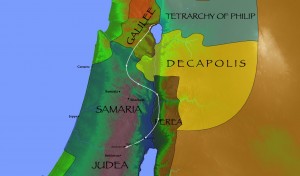
This account we read in Mark’s Gospel describes the journey that Jesus began towards Jerusalem. Jesus had spent most of his time in and around Galilee, but at a certain time, he set out for Jerusalem. He and his disciples and usually a large crowd, went from Galilee to Samaria, then through the area called Perea, and then finally on to Judea and Jerusalem. Up until this point, the disciples had enjoyed their time with Jesus, it was good to be walking with the amazing miracle worker. I am sure if they had facebook back then, they would have posted pictures and selfies of their time with him. They were on an emotional high, things were going well, but then the mood shifted. Jesus got serious and began to stride a little more purposefully. Is seems like Jesus changed gears and began to lock in on a goal that was over the horizon.

Jesus

Luke 12:51 says; “When the days drew near for him to be taken up, he set his face to go to Jerusalem.” Jesus was on a timeline, history was about to change. The creator was about to sacrifice himself for the creation.

Up until this time we see many occasions when Jesus had held back because the timing was not yet right.

The Gospel of John frequently refers to the fact that Jesus was on a timeline. (see, John 7:6, John 7:30 and John 8:20). Jesus was listening to His Father and the schedule was to be kept.

So the time was now, Jesus knew his purpose and he set his face to Jerusalem. In Isaiah 50:7 we see the remarkably accurate picture of Jesus at this moment; “Because the Sovereign Lord helps me, I will not be disgraced. Therefore have I set my face like flint, and I know I will not be put to shame.” Jesus is the one who sets his face like a flint, knowing that he will not be put to shame, knowing that he has a task to perform.

Flint is a very hard sedimentary rock, that when it is hit against steel it produces a spark. The picture of setting one’s face like a flint is focusing on the goal, knowing that you are going to encounter opposition. Taking the adversity and challenges in stride, knowing that there is a bigger purpose and goal. Jesus knew that he was going to Jerusalem to encounter incredible suffering and shame, so he literally steeled himself and with eyes on the horizon, he gritted his teeth and moved forward.

In Mark 10:32 we see one moment they are walking through the hills of Galilee and Samaria, and the next Jesus begins walking out in front. The disciples were “astonished” as they observed Jesus. And the crowd following were “afraid”. The Greek words used here seem to indicate a fear that something bad was about to happen. The disciples who had walked with Jesus for three years, had never seen him like this before. Jesus seemed different, his demeanor had changed, and he became extremely serious and focused.

And the crowd was afraid, they began to fear that something bad was about to happen in Jerusalem. Why was Jesus suddenly so solemn? Suddenly it must have dawned on the crowd, that there was a cost involved in following Jesus – it might cost them their lives.

And today there is a cost involved in following Jesus, and it does involve you losing your life. You have to be prepared to give up everything for him. Dying to ourselves and our own selfish ambitions is the only way to live as a Christian.

The crowd and the disciples were faced with a choice; “am I in or out?” We too are faced with that decision, there is no middle ground – either we follow Jesus to the cross or we may as well turn around and go back home.

But this is not the walk of a man who is walking to his death, it is not the walk of a man who is consigned to the fact that he has to go and suffer a cruel death. Not at all, this was the march of a warrior heading into battle, it was the march of our warrior King about to head into the decisive battle in all of history. Jesus knew that this was his purpose, he was going to destroy death and sin by going to Jerusalem.

When Jesus turned his face like a flint towards Jerusalem, he knew that it meant his death was coming soon. He knew that he was about to have his flesh torn off his back by whips, he knew that he was going to be mocked, spat on, treated shamefully, and then die on the cross, the most cruel form of execution. Jesus also knew that he would face the wrath of God, his father as he paid the price for your sin and mine.

The disciples noticed the shift in the atmosphere, the crowd sensed something big was about to happen, and yet they followed. Some followed out of curiosity, some followed out of love for Jesus, some followed because Jesus had healed them.

Are you following? Have you made a decision to follow Jesus Christ as your personal Lord and savior? Jesus took this journey for you, so that you and I would not have to face an eternity in hell being separated from God. When Jesus began this journey, he was thinking about you.

You may have made a decision to follow Jesus a long time ago, but the distractions and temptations of the world have slowed you down. Jesus calls us to daily take that walk to Jerusalem with him, to walk with purpose and determination. Is your mind set like a flint on following Jesus? Or are you wavering?

Are you following at a distance, not sure if you are going to be able to continue the journey? Maybe the cost seems to be too high. Maybe the challenges and temptations of this world are becoming too strong.

I want to encourage you today to recommit to walking with determination.

O you redeemed ones, on whose behalf this strong resolve was made—you who have been bought by the precious blood of this steadfast, resolute Redeemer—come and think awhile of Him, that your hearts may burn within you and that your faces may be set like flints to live and die for Him who lived and died for you!”

— C.H. Spurgeon

Revival Part 5 The Conditional Preposition

tounge-of-fire-32

There are two all-encompassing verses in the Bible that relate to salvation and revival.

  • John 3:16 tells us all we need to know about the way to salvation.
  • 2 Chronicles 7:14 practically tells us all we need to know about the way to revival.

For the next few weeks we are going to look at this verse in Detail – 2 Chronicles 7:14; “ if my people, who are called by my name, will humble themselves and pray and seek my face and turn from their wicked ways, then I will hear from heaven, and I will forgive their sin and will heal their land.

The verse starts with that powerful conditional preposition – “if”.

It has been said that a preposition can alter a proposition, and that is very clear from this powerful promise of God.

Whatever part God plays in a spiritual re-awakening, we have a part to play too. As we have already stated, a revival is the work of God and no-one can take credit for it, however as we see throughout scripture, there is a responsibility that is ours in every move of God.

On the one side we have the sovereignty of God, it is the almighty God who decides when and how to move in revival. However the divine sovereignty of God does not relieve us of our responsibility. There are things that we can and need to do in order to bring revival closer. A famous Welsh revivalist once said; “Revival comes from God but it is borne to earth on the wings of fervent, believing prayer.”

The Word “IF” is a conditional word and the Bible has many examples of the conditional nature of the blessings of God. Here are just two examples.

Now on the last day, the great day of the feast, Jesus stood and cried out, saying, “If anyone is thirsty, let him come to Me and drink.” John 7:37

But if you do not forgive others, then your Father will not forgive your transgressions.” Matthew 6:15

The Bible has many verses that encourage that when we need a spiritual re-awakening, we must start with our own sinful condition and come to God in repentance.

Call to Me and I will answer you, and I will tell you great and mighty things, which you do not know.’ Jeremiah 33:2

Return, O faithless sons, I will heal your faithlessness.” “Behold, we come to You; For You are the Lord our God.” Jeremiah 3:22

 “But I have this against you, that you have left your first love.  Therefore remember from where you have fallen, and repent and do the deeds you did at first; or else I am coming to you and will remove your lampstand out of its place—unless you repent.” Revelation 2:4-5

Take words with you and return to the Lord. Say to Him, “Take away all iniquity and receive us graciously, that we may present the fruit of our lips.”” Hosea 14:2

Run the Race Part 3 February 28, 2016

Run The Race 3 Title.2

Philippians 3:12-21

All this talk of running and discipline and hard work, sounds like the Christian life is not that pleasant, why would we encourage others to a life of discipline and suffering.

The truth is, the Christian life is a race that has a very definite purpose, it is not aimless or a fruitless exercise, there is a definite goal and a prize that we are running for.

Paul wrote this letter to the Philippian church to encourage them and to keep them growing in their new Christian walk. Although Paul was a spiritual giant in the eyes of the Philippian saints, he wanted them to know that he had not yet attained the goal                      (Philippians 3:10-11).

He was still actively pressing on. He had by no means reached the final stage of his sanctification.

Paul’s salvation experience had taken place about 30 years before he wrote to this letter. He had won many spiritual battles in that time. He had grown much in those years, but he candidly confessed he had not obtained perfection. This testimony of the apostle reminded the saints at Philippi—and it serves to remind believers today—that there must never be a stalemate in their spiritual growth or a plateau beyond which they cannot climb. We must never settle. Are you closer to Jesus today than you were a year ago? There is no standing still as a Christian, either we are becoming more like Christ, or we are losing ground.

Then Paul says in verse 13; “Brethren, I do not regard myself as having laid hold of it yet; but one thing I do: forgetting what lies behind and reaching forward to what lies ahead”. This applies to us today both individually and as a church. We cannot grow in our Christian walk by looking back. The old idiom applies here; “to rest on one’s laurels”, looking back and thinking that enough has been done to secure victory. This applies to us individually, if we are still here, we are still in the race.

Then it applies to us corporately, we must never look back at the wonderful accomplishments of our church and say, look what we did back then – those were the great days – we have done enough. No, God is not done with His Church yet, He has much more in store for this church. Because this is His Church, and He has promised to build His Church, and he has promised to come back for His Church.

Paul goes on to encourage the Philippians to follow his example, and the example of others who are running the race with success (3:17). Paul had noticed that there were people in the Philippian church who were not setting a good example for the believers, and he points them out in verse 19.

Notice Paul is not referring to people outside the church, he is warning them about people inside the church, who are heading for destruction. They are only focused on temporal things, what makes me feel good now.

Their lives show no evidence of Jesus Christ being Lord.

Are you looking at temporal things, and making them more important in your life than eternal things? Remember your citizenship (3:20). If you have made Jesus Christ Lord of your life, you will know what it means to live with eyes fixed on eternity. Every decision you make in your life here in this life, affects eternity.

And then in verse 21, Paul explains why he is running the race, what is the purpose of it all. I am sure many of you are looking forward to that, a new body a supernatural body that will never experience decay or pain. That surely is a prize, surely that is a reward running after?

But that is only a part of it.

None of us have seen heaven, so to it is impossible to fully describe heaven and even if we did get a glimpse, we would find that our vocabulary was inadequate to describe it.

The Bible also tells us that the followers of Jesus will get rewards, James talks about the crown of life (James 1:12). Paul mentions the crown that will last forever (1 Corinthians 9).

But the primary joy of heaven will be far superior to all of that. We will be in the presence of God.

We were made to have communion with God, God created man in his own image to have fellowship with him. But when sin entered the world, that relationship was broken and there was a separation that took place. Inside every human being is a longing and an unfulfilled desire that can only be met by the perfect presence of God himself (see Ecclesiastes 3:11).

Looking at Revelation 3:11-12 and the letter to the church in Philadelphia, Jesus gives an encouragement to the “one who overcomes” – and keeps running the race. The greatest reward is to be a pillar in the temple of God? Sounds strange doesn’t it. We have no idea what it is like to be in the perfect presence of God. To dwell in his presence and worship Him, will be the most incredible experience of all. That is the greatest prize and that is why David could write as he did in Psalm 27:4.

We are to individually run whatever race or calling that God has set out for us. I cannot run for you, and you cannot run for me. But we are called to run that race with certainty, purpose and intensity.

Run your race to win, to be the best you can be for God where He has placed you.

Be willing to make whatever sacrifices necessary to successfully complete the mission and call God has set out for you.

You only get one run at this life, give it all you have got. Make sure you don’t miss a single opportunity to live fully for Jesus Christ.

“I press on toward the goal for the prize of the upward call of God in Christ Jesus.”

Philippians 3:14


Run the Race Part 2 February 21, 2016

Run The Race 2 Title.2

Romans 8: 1-17

Using the analogy of a race, a marathon, there is so much that we can look at that applies to the Christian life.

We are called to a new life, a life that is led by the spirit, Paul says is that we need to be led by the Spirit of God, as we run the race that God has for us.

Now human nature is that we make rules, and when we disciple new believers, we inadvertently make rules for them to follow, because of the mistakes we made when we were in their position. Sometimes these guidelines can be made to look like laws. Romans 8:2 says; “For the law of the Spirit of life in Christ Jesus has set you free from the law of sin and of death”. When we run the race that is the Christian life, we do things differently, we are not under the law that leads to condemnation and death, but we are led by the Spirit which leads to life and peace.

Our disciplines and our training for the race are not governed by law, but they are governed by the Spirit and this brings life. Verse 11 tells us that the same Spirit of God that raised Jesus from the dead lives in you and me! Our old way of viewing time, money, family, possessions all changes, and we see things from the perspective of heaven.

And then there is the unbelievable promise in God’s word in verse 14, we are called the children of God! I know our minds cannot grasp that, we have no idea what it means to be adopted into the family of God. We are called children of the creator of the universe. And verse 17 says that as a result of our adoption as God’s children, we receive an inheritance. We have an inheritance simply because we believed that Jesus died for our sins. He did it all, we die to our old way of life and begin to live by the Spirit, and we get to receive an inheritance from God.

But as we read verse 17 a little further we read these words: “if indeed we suffer with Him…” Suffering? That is not the wonderful Christian life the Walmart book aisle speaks about? Going back to the analogy of running a marathon, if any of you have run a long race, you will know that there are periods of suffering that you go through, occasionally you will “hit the wall”, using running terminology, when your tank is empty. But you push through, others encourage you, and you reach the finish line. Immediately the suffering becomes something you joke about because it is so small in comparison to the joy of the finish line. Verse 18 sums it up; “For I consider that the sufferings of this present time are not worthy to be compared with the glory that is to be revealed to us..”

Suffering and discipline are a part of the Christian race, but we must not shy away from them, they are building us and growing us to be more like Christ.

Let’s look at four Christian Disciplines that will help us run the race that is set before us:

  1. Reading and meditating on God’s word

This Bible is contains your heavenly Father’s love letter to you– it is your daily bread – it is your sword of the spirit – it is the truth that gives light to your path.

It is no ordinary collection of pages and ink. It is supernatural in its authoring, it is supernatural in its reading and it is supernatural in its application (2 Timothy 3:16-17).

If you are led by the Spirit, you will need the sword of the spirit.

Do we daily discipline ourselves to read, study, meditate on the word of God?

  1. Prayer

Prayer is a discipline, it is hard work, when we don’t discipline ourselves to spend time alone with God we limp along in the Christian race, missing out on so much that God has for us. Discipline yourself to pray, it will transform your life and the race God has called you to.

  1. Tithing

Tithing is something we seldom view as a discipline, but the way we handle our finances is either worship or it is idolatry. Either God is more important than your money, or your money is more important than God in your life.

We don’t tithe because God needs our money, he already has all things. No, we tithe because it is worship. Tithing is an act of worship, because many times we look at our income and our expenses and wonder how we can afford to give 1/10 of our income to the Lords work. Well if the Bible is correct, and we know it is, how can we afford not to give to the Lord, knowing that he is our provider and that he will take care of all of our needs (see 2 Corinthians 9: 6-8). You will have all you need to do the will of God for your life.

  1. Evangelism

Evangelism is a spiritual discipline that we are all called to participate in. Evangelism that is led by the Spirit is a joy and a blessing, but we make it out to be a fearful chore.

Evangelism that is fruitful and effective is evangelism that is led by the Holy Spirit. Daily discipline ourselves to pray: “Lord bring someone into my path today who needs a touch from heaven, let me be used by you, almighty God, to bring a miracle to someone’s life” That is the discipline, being available, daily being led by the Spirit to look for the person that God wants to touch through your life story (see 2 Peter 3:15).

Notice two aspects in this verse: firstly – it starts with “revere Christ as Lord”. If Jesus Christ is truly Lord of your life, it will be evident to those around you and your life will be a testimony for Jesus.

Secondly: “always be prepared to explain the reason for your hope” – because, if you are living by the Spirit, people are going to want to know why you are different.

Remember not everyone is gifted as an evangelist, but we are all called the spiritual discipline of sharing the story that God has given us and the reason for our hope.

Remember that the Christian life is a race, it is not a stroll or a wandering along the pathway, there is a very definite end goal. And to keep us running diligently we need to develop Spiritual disciplines, Prayer, Reading God’s Word, Tithing and Evangelism are just a few of them.

But why do we do them?

Because they are good for us? Or because we become more fruitful and lead others to Christ? Yes, but there is a greater reason.

We develop Christian disciplines, because our lives will bring Glory to God.

Revival Part 4 – Why we need Revival.

tounge-of-fire-32

As we look through church history and even in the first century church, we see that the church does not always experience and uninterrupted and sustained move of God. There seems to be a waxing and a waning in the spiritual zeal of the church. As we look at the seven churches in the book of Revelation, we see that six out of seven had quenched the Spirit of God and were reprimanded for that.

As we look at the church in the USA today, we see many churches in a state of decline. This has been going on for decades. The Gen X and the Millennial Generation have abandoned the call to attend traditional church. They are not interested in simply attending a church that looks like a social club or a lodge. Particularly Millennials are looking for meaning in life, their generation is marked by people who deeply desire to sacrificially participate in something that makes a difference. In essence they are looking for reality and a fresh move of the Spirit of God.

As we see the decline in the church, we see a rise in Muslim fundamentalism, again, it is young people who want a cause to fight for and a cause to die for.

The world is hungry for truth, new cults seem to appear each week, why? Because people have a God shaped vacuum in their lives that only the Holy Spirit will fill. We as human beings were designed to be in communion with God, we will never be satisfied with anything less.

The church needs revival in order to reawaken the power of God in His church. To point people to the one true God. The Holy Spirit will move in power and we will see millions of people drawn to Jesus Christ as their Lord and savior.

This is not a competition to see who gets the most followers, it is not a battle to see if we can get more converts than the Islam. In the end only the Christians will win. There is only one way to Heaven and only one true God. Our purpose is to be a church that points people to the truth. As we saw revival takes place when people are so moved by the Holy Spirit that they will run to the Christians and ask how they can be saved. That is why we need a revival.

Run the Race part 1 February 14, 2016

Run The Race 1 Title.2

1 Corinthians 9:24-27

Running is such a great analogy for Christianity, and this is a race that we can all run in and are all called to be running in. Being a Christian is hard work, it is a challenge it requires discipline, it must consume you as you give your whole life over to the Lordship of Christ.

The early church in Corinth had a large number of wealthy people, as a result their personal Christian life was characterized by lack of commitment and ease. Something very much like the modern Western church. We don’t like to hear about discipline and sacrifice.

In 1 Corinthians 9, Paul says that he is a slave to the Gospel. Paul is consumed with telling people about Jesus.

Why? Because he encountered the living God – Saul was on the road to Damascus to persecute the church when Jesus interrupted his life and transformed him from a persecutor of the faith to a proclaimer of the Gospel message. When Ananias is called to go and pray for Saul, the angel of the Lord says in Acts 9:16: “for I will show him how much he must suffer for My name’s sake.” And what follows in the ministry of Paul is a theme of suffering, challenge, persecution and trials. He doesn’t run from them, in fact he encourages other believers to embrace the way of suffering and trials (2 Timothy 2:1-10; Philippians 3:13-14; Galatians 2:2; Colossians 2:1; 2 Timothy 4:7).

When we are saved, we turn away from our life before Christ. As Paul writes in Galatians 2:20, we have been crucified with Christ and no longer live, but we have been born again. In many ways, becoming a Christian is easy, Jesus paid the price; all we have to do is to die. Die to our old way of life and allow the Holy Spirit to transform us and change our worldview. Seeing things and living according to the Word of God. The problem with dying to our old self is that we struggle to stay dead. Our old temptations come back, we are frequently reminded by Satan of our past failures and we are tempted to go back to our old ways. The hard work of being a Christian is staying dead!

Paul is calling Christians to a life of discipline. It is hard work, it requires sacrifice. We have to constantly be focused on the goal. The Goal is the prize that Paul talks about, eternal life and the reward that we will receive when we are all judged by Jesus when he comes again, but more about that in two weeks’ time.

We need to notice is that the Christian life is a race not a stroll, it is a hard fought battle not a meandering in the forest. Using the analogy of a race, there is so much that we can look at that applies to the Christian life. In any walk of life, in any sphere of society, nothing is achieved without dedication and discipline, and being a Christian, the stakes are much much higher, we are focused on eternity. The eternal destiny of our own selves and that of those around us.

Running a marathon takes weeks of training and preparation and carefully watching your diet. When an athlete is preparing for the Olympics he/she will go into seclusion and prepare when no one is watching. As a Christian, you don’t have the luxury of stopping the world when it gets crazy and taking a time out. You have to train as you go, prepare as you go. But that place of seclusion, that place of being alone is absolutely vital to our Christian lives. We cannot survive without a regular daily time spent with the Lord in prayer.

Which leads to the next aspect of the marathon race, it would be impossible to run a marathon without Nutrition. As a Christian our refueling is the Word of God, we need a regular daily intake of the word of God. Read the Bible itself, allowing the Holy Spirit to speak to us. Paul writing to the Ephesians says the Bible is the sword of the spirit, it is our only weapon to be used against Satan and his schemes. We need to know where our nutrition comes from and we need to feed on that daily.

Another wonderful part of running a marathon is the people you run with. There is a comradery that develops with others as you encourage one another through tough times and push one another to achieve what we would normally not be able to do. It is much the same in any Christian’s life, we need one another. It is essential and healthy to have time alone with God, but it is also essential to have time together, in community, as we run the race together.

And then finally, some of you may be thinking that this message does not apply to you. You may be elderly and not able to get around as freely as when you were young. You might not have as much energy as the younger folk. But this message is for you too. Everyone’s race is different, your pace may be different, but our destination is the same. Your race may be that of a bedridden intercessor, praying daily for our missionaries, for the lost, for our evangelism efforts. Older folk are not cheering from the sidelines, you are in the race with us all until Jesus calls us home or comes again.

Where are you on that race today?

Maybe you began the race many years ago, but you stalled out and started meandering? Maybe someone or something cut in on you (Galatians 5:7), some challenge, some tragedy, some loss. But Jesus is calling you to get back up and continue to run the race, pressing on to the finish line.

The Christian life is filled with unexplainable joy and peace, and we get to experience the miracles of God on a daily basis. But, at times it is also hard, but we must never take our eyes off of the prize – the day when we get to see Jesus face to face.