Category Archives: Sermons

Run the Race Part 3 February 28, 2016

Run The Race 3 Title.2

Philippians 3:12-21

All this talk of running and discipline and hard work, sounds like the Christian life is not that pleasant, why would we encourage others to a life of discipline and suffering.

The truth is, the Christian life is a race that has a very definite purpose, it is not aimless or a fruitless exercise, there is a definite goal and a prize that we are running for.

Paul wrote this letter to the Philippian church to encourage them and to keep them growing in their new Christian walk. Although Paul was a spiritual giant in the eyes of the Philippian saints, he wanted them to know that he had not yet attained the goal                      (Philippians 3:10-11).

He was still actively pressing on. He had by no means reached the final stage of his sanctification.

Paul’s salvation experience had taken place about 30 years before he wrote to this letter. He had won many spiritual battles in that time. He had grown much in those years, but he candidly confessed he had not obtained perfection. This testimony of the apostle reminded the saints at Philippi—and it serves to remind believers today—that there must never be a stalemate in their spiritual growth or a plateau beyond which they cannot climb. We must never settle. Are you closer to Jesus today than you were a year ago? There is no standing still as a Christian, either we are becoming more like Christ, or we are losing ground.

Then Paul says in verse 13; “Brethren, I do not regard myself as having laid hold of it yet; but one thing I do: forgetting what lies behind and reaching forward to what lies ahead”. This applies to us today both individually and as a church. We cannot grow in our Christian walk by looking back. The old idiom applies here; “to rest on one’s laurels”, looking back and thinking that enough has been done to secure victory. This applies to us individually, if we are still here, we are still in the race.

Then it applies to us corporately, we must never look back at the wonderful accomplishments of our church and say, look what we did back then – those were the great days – we have done enough. No, God is not done with His Church yet, He has much more in store for this church. Because this is His Church, and He has promised to build His Church, and he has promised to come back for His Church.

Paul goes on to encourage the Philippians to follow his example, and the example of others who are running the race with success (3:17). Paul had noticed that there were people in the Philippian church who were not setting a good example for the believers, and he points them out in verse 19.

Notice Paul is not referring to people outside the church, he is warning them about people inside the church, who are heading for destruction. They are only focused on temporal things, what makes me feel good now.

Their lives show no evidence of Jesus Christ being Lord.

Are you looking at temporal things, and making them more important in your life than eternal things? Remember your citizenship (3:20). If you have made Jesus Christ Lord of your life, you will know what it means to live with eyes fixed on eternity. Every decision you make in your life here in this life, affects eternity.

And then in verse 21, Paul explains why he is running the race, what is the purpose of it all. I am sure many of you are looking forward to that, a new body a supernatural body that will never experience decay or pain. That surely is a prize, surely that is a reward running after?

But that is only a part of it.

None of us have seen heaven, so to it is impossible to fully describe heaven and even if we did get a glimpse, we would find that our vocabulary was inadequate to describe it.

The Bible also tells us that the followers of Jesus will get rewards, James talks about the crown of life (James 1:12). Paul mentions the crown that will last forever (1 Corinthians 9).

But the primary joy of heaven will be far superior to all of that. We will be in the presence of God.

We were made to have communion with God, God created man in his own image to have fellowship with him. But when sin entered the world, that relationship was broken and there was a separation that took place. Inside every human being is a longing and an unfulfilled desire that can only be met by the perfect presence of God himself (see Ecclesiastes 3:11).

Looking at Revelation 3:11-12 and the letter to the church in Philadelphia, Jesus gives an encouragement to the “one who overcomes” – and keeps running the race. The greatest reward is to be a pillar in the temple of God? Sounds strange doesn’t it. We have no idea what it is like to be in the perfect presence of God. To dwell in his presence and worship Him, will be the most incredible experience of all. That is the greatest prize and that is why David could write as he did in Psalm 27:4.

We are to individually run whatever race or calling that God has set out for us. I cannot run for you, and you cannot run for me. But we are called to run that race with certainty, purpose and intensity.

Run your race to win, to be the best you can be for God where He has placed you.

Be willing to make whatever sacrifices necessary to successfully complete the mission and call God has set out for you.

You only get one run at this life, give it all you have got. Make sure you don’t miss a single opportunity to live fully for Jesus Christ.

“I press on toward the goal for the prize of the upward call of God in Christ Jesus.”

Philippians 3:14


Run the Race Part 2 February 21, 2016

Run The Race 2 Title.2

Romans 8: 1-17

Using the analogy of a race, a marathon, there is so much that we can look at that applies to the Christian life.

We are called to a new life, a life that is led by the spirit, Paul says is that we need to be led by the Spirit of God, as we run the race that God has for us.

Now human nature is that we make rules, and when we disciple new believers, we inadvertently make rules for them to follow, because of the mistakes we made when we were in their position. Sometimes these guidelines can be made to look like laws. Romans 8:2 says; “For the law of the Spirit of life in Christ Jesus has set you free from the law of sin and of death”. When we run the race that is the Christian life, we do things differently, we are not under the law that leads to condemnation and death, but we are led by the Spirit which leads to life and peace.

Our disciplines and our training for the race are not governed by law, but they are governed by the Spirit and this brings life. Verse 11 tells us that the same Spirit of God that raised Jesus from the dead lives in you and me! Our old way of viewing time, money, family, possessions all changes, and we see things from the perspective of heaven.

And then there is the unbelievable promise in God’s word in verse 14, we are called the children of God! I know our minds cannot grasp that, we have no idea what it means to be adopted into the family of God. We are called children of the creator of the universe. And verse 17 says that as a result of our adoption as God’s children, we receive an inheritance. We have an inheritance simply because we believed that Jesus died for our sins. He did it all, we die to our old way of life and begin to live by the Spirit, and we get to receive an inheritance from God.

But as we read verse 17 a little further we read these words: “if indeed we suffer with Him…” Suffering? That is not the wonderful Christian life the Walmart book aisle speaks about? Going back to the analogy of running a marathon, if any of you have run a long race, you will know that there are periods of suffering that you go through, occasionally you will “hit the wall”, using running terminology, when your tank is empty. But you push through, others encourage you, and you reach the finish line. Immediately the suffering becomes something you joke about because it is so small in comparison to the joy of the finish line. Verse 18 sums it up; “For I consider that the sufferings of this present time are not worthy to be compared with the glory that is to be revealed to us..”

Suffering and discipline are a part of the Christian race, but we must not shy away from them, they are building us and growing us to be more like Christ.

Let’s look at four Christian Disciplines that will help us run the race that is set before us:

  1. Reading and meditating on God’s word

This Bible is contains your heavenly Father’s love letter to you– it is your daily bread – it is your sword of the spirit – it is the truth that gives light to your path.

It is no ordinary collection of pages and ink. It is supernatural in its authoring, it is supernatural in its reading and it is supernatural in its application (2 Timothy 3:16-17).

If you are led by the Spirit, you will need the sword of the spirit.

Do we daily discipline ourselves to read, study, meditate on the word of God?

  1. Prayer

Prayer is a discipline, it is hard work, when we don’t discipline ourselves to spend time alone with God we limp along in the Christian race, missing out on so much that God has for us. Discipline yourself to pray, it will transform your life and the race God has called you to.

  1. Tithing

Tithing is something we seldom view as a discipline, but the way we handle our finances is either worship or it is idolatry. Either God is more important than your money, or your money is more important than God in your life.

We don’t tithe because God needs our money, he already has all things. No, we tithe because it is worship. Tithing is an act of worship, because many times we look at our income and our expenses and wonder how we can afford to give 1/10 of our income to the Lords work. Well if the Bible is correct, and we know it is, how can we afford not to give to the Lord, knowing that he is our provider and that he will take care of all of our needs (see 2 Corinthians 9: 6-8). You will have all you need to do the will of God for your life.

  1. Evangelism

Evangelism is a spiritual discipline that we are all called to participate in. Evangelism that is led by the Spirit is a joy and a blessing, but we make it out to be a fearful chore.

Evangelism that is fruitful and effective is evangelism that is led by the Holy Spirit. Daily discipline ourselves to pray: “Lord bring someone into my path today who needs a touch from heaven, let me be used by you, almighty God, to bring a miracle to someone’s life” That is the discipline, being available, daily being led by the Spirit to look for the person that God wants to touch through your life story (see 2 Peter 3:15).

Notice two aspects in this verse: firstly – it starts with “revere Christ as Lord”. If Jesus Christ is truly Lord of your life, it will be evident to those around you and your life will be a testimony for Jesus.

Secondly: “always be prepared to explain the reason for your hope” – because, if you are living by the Spirit, people are going to want to know why you are different.

Remember not everyone is gifted as an evangelist, but we are all called the spiritual discipline of sharing the story that God has given us and the reason for our hope.

Remember that the Christian life is a race, it is not a stroll or a wandering along the pathway, there is a very definite end goal. And to keep us running diligently we need to develop Spiritual disciplines, Prayer, Reading God’s Word, Tithing and Evangelism are just a few of them.

But why do we do them?

Because they are good for us? Or because we become more fruitful and lead others to Christ? Yes, but there is a greater reason.

We develop Christian disciplines, because our lives will bring Glory to God.

Run the Race part 1 February 14, 2016

Run The Race 1 Title.2

1 Corinthians 9:24-27

Running is such a great analogy for Christianity, and this is a race that we can all run in and are all called to be running in. Being a Christian is hard work, it is a challenge it requires discipline, it must consume you as you give your whole life over to the Lordship of Christ.

The early church in Corinth had a large number of wealthy people, as a result their personal Christian life was characterized by lack of commitment and ease. Something very much like the modern Western church. We don’t like to hear about discipline and sacrifice.

In 1 Corinthians 9, Paul says that he is a slave to the Gospel. Paul is consumed with telling people about Jesus.

Why? Because he encountered the living God – Saul was on the road to Damascus to persecute the church when Jesus interrupted his life and transformed him from a persecutor of the faith to a proclaimer of the Gospel message. When Ananias is called to go and pray for Saul, the angel of the Lord says in Acts 9:16: “for I will show him how much he must suffer for My name’s sake.” And what follows in the ministry of Paul is a theme of suffering, challenge, persecution and trials. He doesn’t run from them, in fact he encourages other believers to embrace the way of suffering and trials (2 Timothy 2:1-10; Philippians 3:13-14; Galatians 2:2; Colossians 2:1; 2 Timothy 4:7).

When we are saved, we turn away from our life before Christ. As Paul writes in Galatians 2:20, we have been crucified with Christ and no longer live, but we have been born again. In many ways, becoming a Christian is easy, Jesus paid the price; all we have to do is to die. Die to our old way of life and allow the Holy Spirit to transform us and change our worldview. Seeing things and living according to the Word of God. The problem with dying to our old self is that we struggle to stay dead. Our old temptations come back, we are frequently reminded by Satan of our past failures and we are tempted to go back to our old ways. The hard work of being a Christian is staying dead!

Paul is calling Christians to a life of discipline. It is hard work, it requires sacrifice. We have to constantly be focused on the goal. The Goal is the prize that Paul talks about, eternal life and the reward that we will receive when we are all judged by Jesus when he comes again, but more about that in two weeks’ time.

We need to notice is that the Christian life is a race not a stroll, it is a hard fought battle not a meandering in the forest. Using the analogy of a race, there is so much that we can look at that applies to the Christian life. In any walk of life, in any sphere of society, nothing is achieved without dedication and discipline, and being a Christian, the stakes are much much higher, we are focused on eternity. The eternal destiny of our own selves and that of those around us.

Running a marathon takes weeks of training and preparation and carefully watching your diet. When an athlete is preparing for the Olympics he/she will go into seclusion and prepare when no one is watching. As a Christian, you don’t have the luxury of stopping the world when it gets crazy and taking a time out. You have to train as you go, prepare as you go. But that place of seclusion, that place of being alone is absolutely vital to our Christian lives. We cannot survive without a regular daily time spent with the Lord in prayer.

Which leads to the next aspect of the marathon race, it would be impossible to run a marathon without Nutrition. As a Christian our refueling is the Word of God, we need a regular daily intake of the word of God. Read the Bible itself, allowing the Holy Spirit to speak to us. Paul writing to the Ephesians says the Bible is the sword of the spirit, it is our only weapon to be used against Satan and his schemes. We need to know where our nutrition comes from and we need to feed on that daily.

Another wonderful part of running a marathon is the people you run with. There is a comradery that develops with others as you encourage one another through tough times and push one another to achieve what we would normally not be able to do. It is much the same in any Christian’s life, we need one another. It is essential and healthy to have time alone with God, but it is also essential to have time together, in community, as we run the race together.

And then finally, some of you may be thinking that this message does not apply to you. You may be elderly and not able to get around as freely as when you were young. You might not have as much energy as the younger folk. But this message is for you too. Everyone’s race is different, your pace may be different, but our destination is the same. Your race may be that of a bedridden intercessor, praying daily for our missionaries, for the lost, for our evangelism efforts. Older folk are not cheering from the sidelines, you are in the race with us all until Jesus calls us home or comes again.

Where are you on that race today?

Maybe you began the race many years ago, but you stalled out and started meandering? Maybe someone or something cut in on you (Galatians 5:7), some challenge, some tragedy, some loss. But Jesus is calling you to get back up and continue to run the race, pressing on to the finish line.

The Christian life is filled with unexplainable joy and peace, and we get to experience the miracles of God on a daily basis. But, at times it is also hard, but we must never take our eyes off of the prize – the day when we get to see Jesus face to face.

Jesus is the Bread of Life February 7, 2016

Bread Of Life Title.2

Mark 8:11-21

Have experienced a miracle?

Maybe eyesight or hearing restored, cancer taken away? Those certainly are miracles, but what about the car accident you avoided because you were briefly delayed, the financial provision that came in at just the right time, the person who came into your life for a short season and gave you the encouragement you needed to carry on. Those are all miracles, but we don’t often recognize them as such. What about the miracles we don’t know about, the times God protected you or provided for you without your knowledge.

As Christians we have all experienced many miracles.

In Mark 8 verse 11, we read that the Pharisees came to test Jesus, to see if he would prove himself by performing some sign. But we read that Jesus sighed deeply. He was frustrated that although he had given so many signs, they still did not see. Their hearts were hardened. Jesus did not have time for the Pharisees and their intentional hard heartedness, so they got back in the boat and left. The disciples began to get hungry and realized that they did not have much food, whose responsibility was it to bring the food? Here they were on a journey in the Sea of Galilee, not knowing where Jesus is going to go next, without any food.

Jesus knows what they are discussing and responds with a strange warning; “15 Be careful,” Jesus warned them. “Watch out for the yeast of the Pharisees and that of Herod.”

The disciples were obviously confused, they thought he was referring to the fact that they had no bread. Jesus often spoke in parables and sometimes confusing metaphors, maybe this was another one. But Jesus was trying to take their attention away from their physical need that was consuming their thinking. How often God needs to do that? Take our minds off the thing that is consuming our attention, the temporal thing, and allow us to focus on the bigger picture. Jesus was getting them to focus on the bigger picture.

The yeast of the Pharisees and that of Herod – what was Jesus talking about here? Jesus was warning them of false teachers and those who had a false understanding of who Jesus was. A small amount of yeast affects the whole loaf just like a small amount of doubt and fear affects a whole church and a whole community. Let us be very careful of those who spread fear and doubt. We serve a living God who is still at work in the world today to bring about his plans for his ultimate Glory. Jesus showed that he was more than adequate to provide for their immediate needs. And he still does today.

Jesus starts questioning the disciples and asks 7 questions, but the first five, he shoots out not expecting or requiring an answer to them (Mark 8:17-18). Jesus is like a parent scolding a child.

In asking these questions, Jesus quotes Jeremiah 5:21 and says; “Do you have eyes but fail to see, and ears but fail to hear?” Jesus was not accusing them of being deaf and blind, rather he was pointing to his miracles. He was reminding them of who he was and what he was capable of doing. Looking back in Mark 7, we see that before the miracle of the feeding of the 4000, Jesus had healed a man who was deaf and mute. Then there was another miracle, right after this account of Jesus rebuking his disciples, Jesus heals the blind man at Bethsaida (Mark 8:22).

But Jesus goes on and asks them questions about the two miracles of the large crowds that he fed only a few days before.

Jesus probably lowered his voice and in what might have sounded like a sigh, he says; “Do you still not understand?

The disciples had seen incredible miracles, they had seen Jesus feed thousands with a small amount of food. They had seen him restore healing, cast out demons, they had seen him walk on water. They should have understood that Jesus could do anything, but what Jesus was trying to get them to understand was that miracles are not meant for simply the physical provision or correction of something that was out of alignment. Jesus wanted them to be thinking on a spiritual level. Do they know who Jesus is?

And we are not much different. We may experience a miracle, God provides, God opens a door for us, God blesses us, and in a few weeks we forget what God has done, we forget the miracle.

Christians are the beneficiaries of the greatest miracle, the greatest story of all of History, the Good News.

Jesus died and rose again from the dead in order to reconcile us to God. As a result we don’t have to live in fear and uncertainty. The world is a scary place if we don’t know Jesus. If we don’t see and hear what he has done, and what he is still doing.

So why does God do miracles? To make us more comfortable? To help us out of a difficult situation?

Does God do miracles because He realized he made a mistake and quickly has to correct it? No God doesn’t do that. God allows situations in our lives, desperate situations, situations that only He could take care of, in order for us to see His glory, His mercy and His power.

God is less concerned about our personal comfort here on earth than he is concerned about us spending eternity with him.

Through miracles God displays His glory, through miracles God grows our faith and trust in Him. God sends miracles so that we can worship Him.

Tell someone what God has done for you. Your story is your testimony, you need to share your testimony to point others to the glory of God.


“Do this in Remembrance of Me” January 24, 2016

The Lord's Supper Title.2

1 Corinthians 11:23-34

We all struggle to remember things from time to time, some are better than others at remembering names and dates. Jesus knows that we have a tendency to forget, in fact Jesus spoke in parables so frequently because he knew it was the best way for people to remember. Strange – the creator of the universe knowing what is the best way to communicate to his creation!

But the bible is largely narrative, in fact 24 books of the bible are almost completely narrative. Why? Because we remember stories, we remember pictures, we remember illustrations. Jesus often used word pictures and practical illustrations to teach, and he left us with two ordinances in the church. Two practical things to do that when we understand them, we know all we need to know about the Gospel and our salvation. The two ordinances are Baptism and the Lords supper.

Today we will be joining together in remembering the Lords supper, as we do every month. Unfortunately it can become a routine, and along with a routine, we can lose significance. These symbols and this practice is a remembrance of the very foundation of our Christianity. This is the Gospel of Jesus Christ, the Good news proclaimed. Jesus instituted the Lords supper during his last supper with the disciples (see Luke 22).

Map-of-Achaia-color

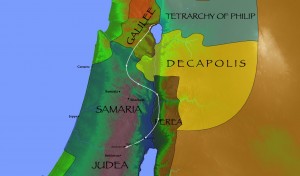
The church in Corinth to whom Paul was writing in 1 Corinthians 11, was established around AD 50 as Paul went there on one of his missionary Journeys. Corinth was a wealth trading city in ancient Greece, as a result of being in a key position in a trading route between the mainland of Greece and the area called the Peloponnese. Paul become very familiar with the area and the people as he spent 18 months there on his second missionary journey.

But the young church in Corinth was not doing well. They gathered together frequently but as we read from the letters of Paul to the church, they had a lot of problems. One of the problems he had to address was the abuse of the Lords supper. Instead of a solemn reminder of the Lords Death, it had become a feast, a glorified pot-luck. People were bringing food and then gathering in corners of the room and feasting, even getting drunk, while others were left out, without food and going hungry. As a result of being in a wealthy region of trade, there was a large gap between the wealthy and the poor, and the meal that they shared together highlighted the fact of these differences, people were forming cliques with other wealthy people and ignoring the needs of others.

Paul was drawing them back to the real reason for the ordinance, the Lords supper is intended to show the selfless act of Jesus in sacrificing his own body. The remembrance of the overwhelmingly generous act of Jesus on the cross, was now being corrupted by the selfish attitudes of the wealthy, what a contrast.

The body of Christ, the church is supposed to be the one place where we are all on the same footing. This is the level playing field, where no-one is better than another. No matter how much money or how little money one has, we are all equal before the cross of Jesus Christ. We are all sinners in need of a savior, we are all desperately poor until we come to the cross and make Jesus Christ Lord of our lives.

Paul goes on in verses 28-32 to warn them that the consequences of eating and drinking the elements in an unworthy manner will result in sickness and even death. Today when we remember the Lords supper, we always give a time to allow us to reflect and allow the Holy Spirit to convict us of sin in our lives. Particularly of sins between members of the Body of Christ. This is what Paul us talking about here. If you and I have anything against someone else, we need to make that right, don’t simply go on and take the elements as if nothing is wrong. It is better for us not to take the elements than to receive punishment from God.

There are two types of people who should not participate in the Lords supper. The first is unbelievers, those who do not know Jesus as their personal Lord and Savior. The symbols mean nothing to them. The second group is people who are Christians, but for whatever reason, they are not right with the Lord. There is sin in their lives, or there is a relationship with another believer in the church that is not right.

We need to eliminate the stigma of not taking the elements. As you pray, if the Holy Spirit convicts you of something that is not right, do not participate, it is much better for you not to.

As Paul stressed that the Lords supper was intended to build up unity and a common bond between believers, because it reminds us of the selfless act of Jesus, this time before the table of the Lord should always bring greater unity in the church.

The unique aspect about the Lords supper is that it incorporates all the senses, thus we have no excuse for forgetting. Jesus knows that we are prone to forget him in our busy daily schedules.

But these symbols will mean nothing to you if you don’t know Jesus as your personal savior. They serve as a reminder, but you cannot remember what you do have not experienced personally. Do you know Jesus as your Lord and Savior?

Remembering what Jesus has done for you on the cross must affect every aspect of your life.

By remembering what Jesus has done for you, you will be able to face challenges of life, you will be able to withstand temptation and overcome the plans that Satan has for your life and you will be able to stand before a gravestone of a loved one and celebrate because you know that there is a glorious hope beyond the grave.

This table reminds us that Satan has been defeated, and that Jesus is coming again!

Be Still and Know – Psalm 46 Part 3 1/17/16

Be Still and Know that I AM God.

Psalm 46  Title part 3.2

Psalm 46


Over the last two weeks we have looked at this Psalm and seen that we are commanded not to fear, and we are challenged to be still before God. But there is a bigger question that we need to be asking, why? Why should we not be afraid? Why should we be still? What is the motivation? Looking again at verse 10; “Be still and know that I AM God.”

If we don’t know God, we have no reason to be still before him. If we don’t know God we can try as much as we like not to fear, we will always live in fear. Without the knowledge of God, life is a futile treadmill of fear and uncertainty.

Some of you may be asking; can we know God? Can we really know God? After all he is Spirit and we are limited by our flesh. He is so awesome, indescribable, all powerful, and all holy. The answer is simply yes, He is knowable. Our God is all of these attributes and much much more, but he is also knowable and approachable.

In Jesus, God became flesh and lived with us. Jesus came to die for your sins and mine, Jesus came to overcome death and conquer sin forever, he came to restore our relationship with God, providing for us a way to be able to pray directly to the Father and show us who the Father is. (See Colossians 1:15 & Hebrews 1:3)

As we look at Psalm 46, we see four attributes of God;

The first attribute we see is found in verse 4; “4 There is a river whose streams make glad the city of God, the holy place where the Most High dwells.” Water is essential for life, every living thing needs water, and throughout the Bible, rivers are depicted as a blessing of God’s provision.

So the first attribute of God that we can know, is that he is our provider. There is nothing that we have that we did not get from God. He created all things, all things belong to him we are blessed by his daily provision. Jesus spent a lot of time in teaching his disciples about the provision of God, In Matthew 6, Jesus tells his disciples not to worry about food and clothing, and that our Heavenly Father knows what we need and He will provide.

The next attribute of God that we find referenced in this Psalm is found in verse 5 which reads; “God is within her, she will not fall; God will help her at break of day.” And verse one reads; “God is our refuge and strength, an ever-present help in trouble.” Not only is God our help in times of trouble, but we need to rely on God at all times to help us. When God calls on us to do something, he doesn’t give us the instructions and then sit back and see if we are able to do what he is calling us to do, He promises to be our helper (see Psalm 20:7).

God doesn’t call you to do something because of your own natural ability.

God may tell you to stand up against injustice, such as abortion or child trafficking, or He may tell you to stop taking drugs, smoking, or an addiction to pornography, God knows you cannot do this in your own strength, but He can help you overcome any challenge (see 2 Corinthians 12:9). God is looking for people who trust him, who rely on him. What is God asking you to do today that seems impossible?

Thirdly we see another attribute of God in verse 7 and verse 11; “The LORD Almighty is with us; the God of Jacob is our fortress”. God is always with us, and he knows exactly what is going on in our lives. God knows what you are going through in your most private times, when the fears of the world seem to come crashing down on you. But notice this, not only is God with us, but the Psalmist reminds us that the Lord Almighty is with us (see 1 John 4:4). If you truly know Jesus Christ as your personal Lord and savior, you have the Holy Spirit residing in you. You have the presence of God with you all the time. Sometimes you may feel alone, but that is where faith steps up and you declare the promises of God. Remember God promises to be with you, he is faithful to that promise. Your feelings must not govern your relationship with God. He calls us to live by faith.

The final attribute of God we see is portrayed in verse 8, which starts with the statement; “Come and see what the LORD has done”. Again we have the picture we have of a soldier on the walls of Jerusalem calling all the people to come and see the destruction that the angel of the Lord had done to the Assyrian Army. 185000 enemy soldiers killed. We see a picture of a God who is able. The Lord God almighty is able to get the job done, he is not weak, but swiftly acts on behalf of his people.

There is absolutely nothing that God calls you to do, that He is not able to accomplish through you.

God cannot use us if we come to him with our credentials, and present them to him as if he will find that he needs us.

God blesses us by calling us to be his vehicles to bless those around us.

Remember the hopeless situation that Hezekiah faced, the next day he would be killed by King Sennacherib. But he went into the temple, laid the letter from Sennacherib before the Lord, he laid the problem before the throne of God and asked God to move on his behalf. Why? Because he knew that God was able.

What is it that you are facing? What is the letter that you have from the enemy, asking you to surrender to fear and stop moving forward? God wants to use that letter from the enemy as a testimony to His Glory.

Be Still and Know – Psalm 46 Part 2 1/10/16

Be Still and Know that I AM God.

Psalm 46  Title part 2.2

Part 2- Psalm 46

Continuing with our series on Psalm 46, and specifically looking at the first part of verse 10. “Be still and know that I AM God.” I want to look at two words in this verse “Be Still”. There are two different translations that we find, and two ways to look at these words.

The first one is translated in the NASB, which says; “cease striving and know that I am God” The dictionary defines to strive as; “to contend in opposition, battle, or to struggle vigorously, as in opposition or resistance:”

Literally what this text is saying is that we must not strive against God. We obviously know that this is stupidity and we would never directly oppose God Almighty. But what about murmuring against God? We have all been guilty at one time or another of complaining or murmuring against God. We don’t have to look further than the children of Israel during the Exodus to see how much their murmuring cost them.

Who are we to complain or murmur to God about what He is doing? We would never call it murmuring, but when we gossip about His church, the Body of Christ, we are murmuring against God. We don’t like what God is doing, but we blame it on someone else, we complain about the younger or older generation, we complain about the Deacons or the Pastor, but what if we are complaining about God’s servants, when in reality, God is answering our prayers for revival but we just don’t like the way in which he is going about it. When you are tempted to complain and gossip, why don’t you stop and pray, and ask God what He is doing? You may find that He says to you, stop striving.

The Prophet Habakkuk complained against God, and God put the world in perspective for him; “The Lord is in his holy temple; let all the earth be silent before him.” Habakkuk 2:20.

The fact that He is God, is sufficient reason why we should be still before Him. Not complaining or murmuring in any way, but calmly acknowledging who He is and submitting to Him.

But there is another way of interpreting this verse and that is the way the NIV puts it; “Be still and know that I AM God”. Literally we need to be still.

Last week we dealt with the way in which we so easily get trapped in fear as we look at our television news or the world around us. The world we live in is a crazy place. Never before in all of history have we had so much information available to us at the push of a button. But this leads to a situation of information overload and a short attention span. We live in the digital age, whether we like it or not. And the result is a tremendous increase in stress related ailments. Our news is often boiled down to 140 character headlines in twitter, or poorly written text messages.

A recent study by Microsoft Corporation has found that the human attention span has shortened from 12 seconds to 8 seconds in the last decade. The average goldfish has an attention span of 9 seconds, so much for evolution! The study said; “Heavy multi-screeners find it difficult to filter out irrelevant stimuli — they’re more easily distracted by multiple streams of media,”

 This digital age has had a dramatic effect on our personal spiritual lives. The shortening of the ability to focus, has made it increasingly difficult for people to pray. As a result many Christians are weak and easily distracted. We are unable to focus on what is really important, because we struggle to filter out that which is mindless noise. If we were honest with ourselves, we would realize that we have some kind of noise in our lives all the time. Whether it is the radio on, or the TV going all day. We have become a people who are afraid of silence. Silence terrifies us because it is in the silence that we have to confront ourselves. We are so inundated by bad news and mostly irrelevant news that we forget about the good news of the Gospel, we forget that Jesus came to set us free from the world and its treadmill.

Don Whitney said; “As sleep and rest are needed for the body, so silence and solitude is needed each day for the soul.”

If you do not have a daily time with the Lord, you are probably not growing as a Christian. You come to church on a Sunday for a boost and a word of encouragement to keep you going, but then you slowly slide back as the week progresses. I cannot stress enough the importance of spending time alone with God in silence. Oswald Chambers wrote in 1936; “Solitude with God repairs the damage done by the fret and noise and clamor of the world.” If he felt that in 1936, how much more do we have to contend for that solitude with God?

What I am talking about here is discipline. The discipline to slow down and hit the off button. This is a fight for our survival, the church is filled with weak Christians because we do not take the discipline of prayer and solitude seriously. This is not for the few, this is for all who identify themselves as followers of Christ.

Read what Jesus said in Matthew 6:6; Jesus doesn’t say, if you pray, but when you pray. It is imperative that prayer be a part of your daily life. Then Jesus said, go into your room – we need to establish a place for prayer. Find a regular place where you can meet with God each day, Jesus goes on to say, close the door. Close the door on the world, that also means for us, don’t take your digital devices into your prayer room. Take a bible, a journal and a pen. Leave the world outside and spend time with God.

When Moses came down off the Mount Sinai after receiving the law from God, we read that his face shone, because he had been in the presence of the Lord. When you leave your home in the morning, do the people you meet know that you have been with Jesus? They should..

Let us learn what it is to once again be still and know that He is God.

Be Still and Know – Psalm 46 part 1 1/3/16

Be Still and Know that I AM God.

Psalm 46 Title part 1.2

Thoughts on Psalm 46 Part 1

Here we are once again at the brink of a new year, a year that will be filled with unexpected things. We don’t know what lies ahead, what joys, sorrows, victories, defeats, good days and bad days.

Looking at Psalm 46, it is clear that this Psalm was inspired by some event that took place at that time and the general consensus is that the Psalmist was writing about an event that took place around 700 BC. The Assyrian army under Sennacherib had marched on Jerusalem, to attack and destroy the city. This took place under the reign of King Hezekiah (see 2 Kings 18 and 19).

The situation looked terrible, the greatest army in the world was laying siege to Jerusalem, Sennacherib was breathing threats of terrible things, and the people were in fear. There was no hope for deliverance, all would surely be lost. But the Lord had raised up this man Hezekiah as a man of faith. When Hezekiah received a letter of ultimatum from the invading Assyrians he did something only a man of faith would do, we read in 2 Kings 19:14; “Hezekiah received the letter from the messengers and read it. Then he went up to the temple of the LORD and spread it out before the LORD.” And few nights later, the angel of the Lord attacked the Assyrian camp and killed 185000 soldiers. When the people woke up the next morning they witnessed the incredible devastation inflicted by the angel of the Lord.

Psalm 46 starts out with that wonderful line; “God is our refuge and our Strength”. God is on our side. He is for us. Refuge indicates a safe place, a place of peace and comfort. God is a mighty fortress, and we can run to him for protection and safety (see Proverbs 18:10). And God is our strength. God is all powerful – our feeble minds have no real grasp of what that means. God is on our side, and will fight for us. The psalmist goes on to say; “an ever present help in trouble”. Literally meaning that God is able to win the victory, and he is ever present, even when the clouds seem the darkest, God is our ever present help.

We live in a day and age that is controlled by fear. Every day we encounter something that we are told we need to fear. But as we look at this Psalm, it seems that in light of all the evident things that one has to fear, the Psalmist wants to make a big statement (see v2 &3), we have a picture here of cataclysmic events; mountains breaking apart and falling into the sea, the sea raging as a tsunami results from the earthquake, no one is safe, no amount of financial security can protect one from this kind of natural disaster. The Psalmist intentionally raises the fear hype to a ridiculous level in order to show that no matter what we fear, no matter how bad things seem to be, God is still on the throne, He is still our refuge and strength.

Jesus had the final word on fear, he made a statement that puts all fear in perspective; Matthew 10:28;”Do not be afraid of those who kill the body but cannot kill the soul. Rather, be afraid of the One who can destroy both soul and body in hell.” Note this is a command; “do not be afraid!” Proverbs 1:7 states; “The fear of the Lord is the beginning of knowledge.”

We have this crescendo of dramatic destruction in verse 2 and 3, and then there is a shift in the Psalm, verse 4 and 5, explain why those listening to this Psalm can have refuge. The Psalmist goes from crashing waves to a calm stream, we have a picture of Jerusalem, with God in her midst. God living in the midst of the people, giving them peace and calm. The Assyrians, were outside the city, building siege ramps, but there was peace in the city of God. The same goes for us, we who have made Jesus Christ Lord of our lives have the Holy Spirit living in us, the same God who calmed the fears of King Hezekiah, the same God who calmed the stormy sea of Galilee, is the God who is able to bring peace into your life in the midst of the raging storm.

But then the victory comes in verse 8 and 9, the sudden destruction of the Assyrian army by the angel of the Lord. Smoke coming up from where the camp of the enemy once stood, and bodies everywhere. Can you imagine the relief, the wonder and praise for God. There must have been a celebration going on. Then there is verse 10; “He says, “Be still, and know that I am God; I will be exalted among the nations, I will be exalted in the earth.” God reminds the people, the Great I AM has one the victory.

The Psalm ends with a reminder that God is with us! We see this echoed in the words of Jesus in Matthew 28:20.

These are such exciting times to be living in, not times of fear. We need to have an eternal perspective as we look at 2016, what is God doing in the nations, what is God doing in America, what is God doing in our city. If you watch and pray and ask God to give you His perspective, you will see many miracles taking place all the time. Our God reigns.

So what is your fear today?

Paul writing to Timothy says; “For God has not given us the spirit of fear; but of power, and of love, and of a sound mind.” The same God who destroyed the Assyrian army, the same God who inspired this wonderful Psalm, is your Heavenly Father, and he wants to calm your fears today and give you peace.

Why Christmas Part 4 12/27/15

#whychristmas

Why Christmas Part 4 Title.2

Acts 1:1-11

So we come to the final questions for our series, and the first is, why must Jesus come again? Acts 1:1-11 is about the ascension of Jesus, it seems to be out of place for us to read at this time of the year.

When we look at the prophets that I mentioned in the first part of the series, I said that there were some prophecies about Jesus that are still to be fulfilled. For example Isaiah 9:6-7 is a scripture that we read every Christmas, but verse 7 is still not fully realized, we wait for the day when justice and righteousness will be established and continue forever.

This is not unusual in the writings of the Old Testament prophets. It is much like looking at a mountain range from great distance, this is how the prophets saw what God was giving them. All the mountains look the same distance away, but as you get closer you see that there are valleys and great distances between the mountains. The Old Testament prophets saw from a distance, but the disciples who walked with Jesus saw the first “mountain” being fulfilled in the presence of Jesus. They believed Jesus when he said that he must go and that he will return again one day. From their vantage point, they looked to another distant mountain, the great Day of the Lord, when Jesus would come as a warrior king, to judge the world and establish his rule and reign.

The first coming of Jesus was a mission of humility and sacrifice, he came to deal with the problem of sin and he came to conquer death. But the next time Jesus comes, he will come on a mission of triumph and justice.

When Jesus comes again, it will be with a loud trumpet blast and fantastic Glory, far different from his humble birth in a manger (see 1 Thessalonians 4:16). Jesus must come in order to receive his Bride the church, and to judge the World. Both the living and the dead, both believers and unbelievers, everyone will stand before the judgment throne. At this time, Jesus will separate his faithful children from those who refused to believe in him. One to eternal reward, the other to eternal punishment. At this time Jesus will establish the New Heaven and the New Earth, all things will be made new. God’s people will live together in perfect fellowship with one another and with our creator. No more sin, no more pain, no more tears. That is why Jesus has to come again, and we eagerly await that day.

We come to our next question, why do you and I need to believe in Jesus? As we look at the Bible’s account of the birth of Jesus in Matthew and Luke, we see many facts, we see the account of Mary and Joseph, the Shepherds, the wise men, and even Herod. All of these people were real people, but only people who witnessed the greatest miracle of all time. The story of Jesus that we remember this week is not simply a story of a life two thousand years ago. The story of Jesus affects all of history and all of mankind. The disciples were given the privilege of seeing Jesus in person, they believed in him because they saw his miracles, and they witnessed his resurrection from the dead. But we have something even more wonderful than that, when Jesus ascended into heaven, he promised the Holy Spirit would come and live within us. The Holy Spirit, the third person of the Trinity actually resides in all who believe in Jesus Christ. The Holy Spirit is our comforter, our counsellor, and our guide in life, we are not left as orphans, we have become Children of the living God. We must believe in Jesus, he is our only hope. When Jesus comes again, it will be too late to then decide to believe in Him.

But I want to challenge you today to consider that believing in Jesus is not enough. In James 2:19 we see that belief in God is not enough unless it is accompanied by a life of faith and action. Merely giving mental agreement to the virgin birth, accepting that Jesus is the Son of God even believing that he came to be a sacrifice for our sins is not enough. Someone who is truly saved is someone who takes the truth of the Gospel, believes it and then acts accordingly, the Gospel message must change our lives. So the third question is why do you need to make Jesus Christ Lord of your life?

In Acts 1:10-11, we see the disciples standing on the Mount of Olives gazing up at the sky. They were staring in a stunned silence, paralyzed in a mixture of confusion, wonder, fear and anxiety. Jesus has just left, what will they do now?

Then almost as if to wake them up, two angels appear in human form, and give them some comfort that Jesus is coming back again. But the truth is that they had a job to do, Jesus had just given them his final instructions (Acts 1:8), and there was work to be done. The disciples needed to be reminded that they were not called by Jesus to sit on top of the Mount of Olives, stargazing and waiting for his return. They were called to go and change the World with a message that was life changing and revolutionary.

And that is our calling too. We are not saved in order to sit back and continue life as normal. How can we continue as normal, when we have received the Holy Spirit? We have the presence of the Living God within us, we have been called with a purpose to give our lives to Christ as living sacrifices. That is what it means to be a Christian, the most incredible privilege and calling any human being can have, to be the representatives of the Living God. As we wait for Jesus to come again let us be about His business, let us be found faithful, doing what God has called us to do.

Why Christmas Part 3 12/20/15

From www.untilallarereached.com

Read: LUKE 2:1-21

As I continue our series on the why of Christmas, today I have three more questions. Why was he given the name of Jesus? Why did the son of God, come to earth as a baby? And finally, I want to pose the question, are you born again?

  • Why is his name Jesus

As Shakespeare once wrote in Romeo and Juliet, “What’s in a name?” We associate people or characteristics to names. Let’s face it, the reason we don’t like certain names is because we know someone by that name that by their actions or their personality, has ruined the name for us.

But the name Jesus is a name that means so much to us. Not because the letters themselves grouped together carry any sort of power in themselves, but the man Jesus gives power to the name.

The name Jesus is the Greek equivalent of the Hebrew “Joshua”, and means, “God Saves”. Now the Hebrew name Joshua, and the Greek equivalent Jesus, were common names at the time of Jesus’ birth. The name Jesus continued to be popular during the life of Jesus, but after he died and rose again, the name was not used much at all. Historians have found that after the 1st century, it seems that the name Jesus simply vanished from use in the region. The name Jesus, took on a much more controversial meaning. For early Christians, the name Jesus means so much that they felt that no child was worthy to carry the same name as the messiah. For those who did not believe that Jesus was the promised messiah, did not want their child to be associated with such a controversial character.

Jesus taking a common name, shows us that he came to the earth as a common person. The people of Israel were looking for someone to come as a mighty warrior as their messiah, they missed him because he came as a carpenter.

But now the name of Jesus means so much more to us, we call on the name of Jesus for our salvation and we pray in the name of Jesus (see 14:13-14 and Acts 4:12). The name of Jesus carries immeasurable power, there is no more powerful name in all the universe than Jesus, not because of the name itself, but because of the One, the Christ, who gives the name power.

  • Why did he come as a baby

Why didn’t he simply appear as a full-grown man, and begin to perform miraculous signs and wonders. Why did Jesus go through all the difficulties and challenges of youth, and then only begin his ministry when he was thirty? The teachers of the day when speaking of the promised Messiah, must have described someone who had the Wisdom of Solomon, the charisma and authority of David, the leadership ability of Moses and the military genius of Joshua. But instead, Jesus comes into the world as a little baby, weak, needy, and humble, just like any other baby.

But Jesus was both God and man, virgin birth is proof that he was divine, he was not a product of this world, he was God, but being born as an infant, shows that he was also human in every way. Jesus went through trials and testing of; childhood, adolescence and being a young man (see Hebrews 4:15).

If Jesus did not take on the form of a man, his sacrifice would have been unconvincing, because he would have been aloof and separated from the common man. If Jesus had been a mere man and not God also, he would have died a martyr’s death, just like thousands of others. We are able to trust this same Jesus with our lives, because he knows what we are going through and he overcame the world and all its temptations.

  • Why you need to be born again

So we come to our last question today, why you need to be born again. Jesus came as a baby, he took on flesh, he took on a new name and he came in order to be the savior of all who would put their trust in him.

Jesus in speaking to the Pharisee named Nicodemus made this profound statement; “Very truly I tell you, no one can see the kingdom of God unless they are born again.” John 3:3. The term Jesus used; “Born again”, can be translated in the Greek to say Born from Above. This means there is a spiritual dynamic to this new birth (Read John 1:12-13). So what does it mean to be born of God? We call this transition by many different names, we say, “I was saved”, “I became a Christian”, “I decided to follow Christ” and “I became a believer”. And for many people what this translates to is a decision to raise your hand in a meeting or walk down the aisle at a service for prayer. But the truth is that there are many people who claim to be Christians, who show no evidence of a transformed life, they show no evidence of being born from above.

Jesus made it clear that to follow him was not a simple decision or a raising of the hand; to follow Jesus means to die to your old self, to take on a new name, to completely give everything you have to God. When we are born again, we take on the name of Jesus, we become so closely identified with him, that we are his ambassadors for Christ, as Paul says in  2 Corinthians 5:20. Do we understand what this means?

He who gave up everything for you and I, asks us to give up everything for him.

Is he Lord of your life? Are you living every day as His ambassador? This is what it means to be a Christian.